
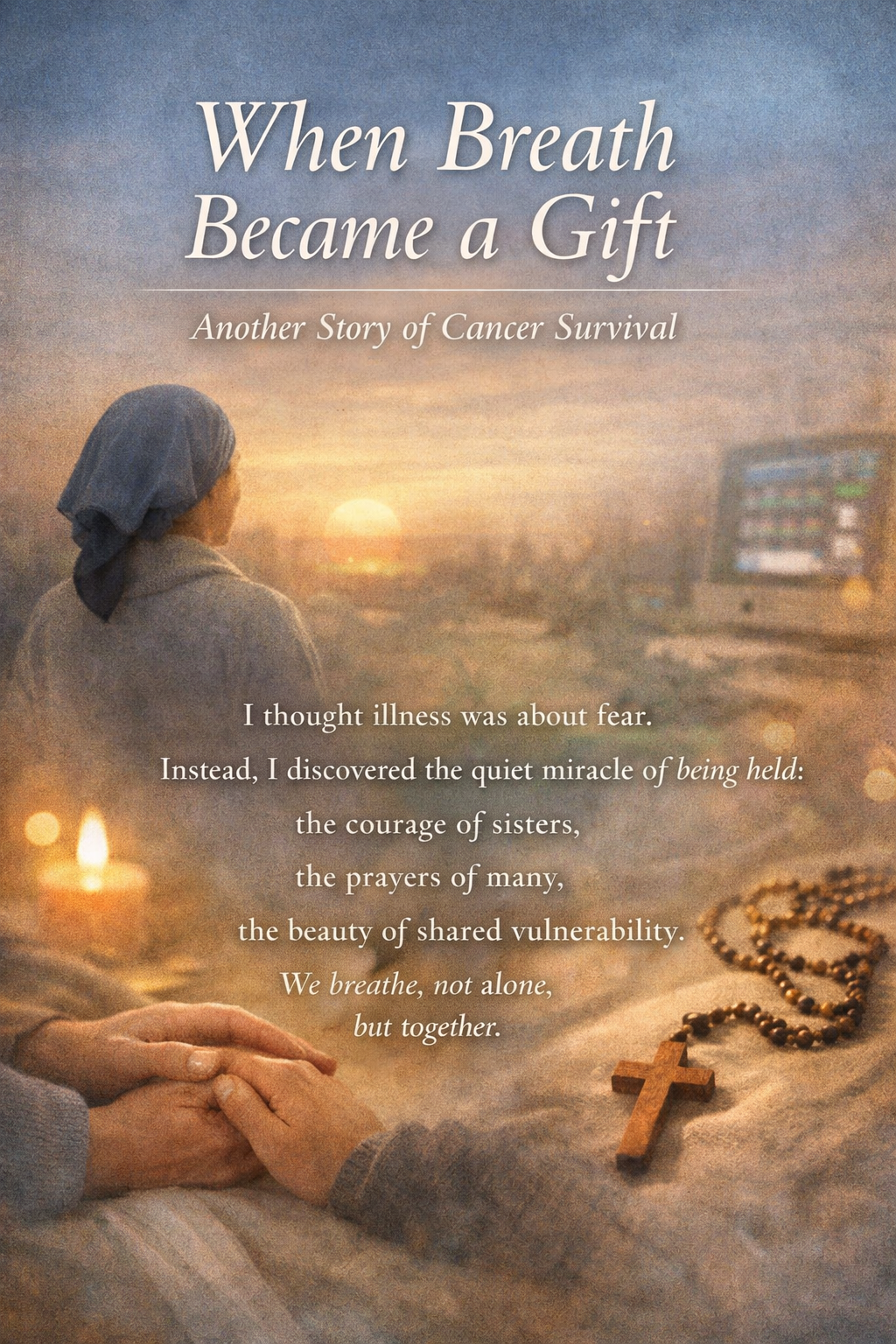
(Another Story of Cancer Survival – and Belonging)
It began with something small — a cough that lingered longer than it should. There was nothing dramatic about it at first. Routine tests were normal. Life continued. Ministry continued. Conversations continued.
And yet the body knew something that the reports did not.
When the CT scan finally revealed a tumour blocking nearly eighty percent of my airway, the word that echoed within me was not “cancer.” It was “breath.” I had been breathing — preaching, praying, laughing — without realizing how fragile that breath had become.
Illness has a way of exposing assumptions. We assume we will wake up. We assume we will breathe. We assume tomorrow belongs to us.
Suddenly, breathing was no longer an unnoticed rhythm. It was a question.
The Quiet Strength of Being Carried
The doctors spoke of risks — respiratory arrest, emergency intervention, possible permanent tracheostomy. The language was clinical, precise. But around me, something else was happening.
My sisters did not dramatize. They organized.
Phone calls were made. Consultations arranged. Travel planned despite the risk. The journey from Nagpur to Kerala was uncertain; even doctors hesitated. Yet my sisters moved with a calm decisiveness that felt like borrowed courage. I did not generate strength. I received it.
That was my first realization: we rarely carry ourselves alone. We are carried — often without noticing.
Illness made that visible.
When Community Becomes Breath
At Amala Cancer Institute in Thrissur, specialists studied the case. Surgeons, pulmonologists, oncologists — many minds focused on one fragile airway. Plans were drawn for major surgery.
Meanwhile, in places I could not see, prayer began to circulate. Eucharistic adorations, rosaries, quiet intercessions in chapels and hospital rooms. It was not organized as a campaign. It flowed naturally.
For the first time, I sensed something deeply theological in a bodily way: community is not an abstract idea. It is a living organism. When one member struggles to breathe, others begin breathing more consciously.
I realized that my life extended beyond my own lungs.
Learning to Imagine Loss
While awaiting biopsy results, I met a patient living with a permanent tracheostomy. I watched the effort of speaking through a new opening in the throat. I wondered what it would mean if my own voice changed like that.
What is a religious sister without her voice?
What is ministry without speech?
What is identity when breath is altered?
Illness forces us to imagine versions of ourselves we never prepared for.
It was not fear that dominated those days — it was surrender to uncertainty. The Rosary became less a petition for cure and more a rhythm that steadied the heart. My mother’s faithful repetition of Hail Marys was not dramatic faith. It was daily trust. Through her, I learned that faith does not eliminate vulnerability; it accompanies it.
The Word “Benign”
When the final biopsy result arrived, the word was simple: benign.
There was relief, yes. Gratitude, certainly. But the deepest transformation had already occurred before that word came. The tumour had not yet been removed, but something within me had shifted.
I was no longer alone inside my body.
The surgical plan changed — minimally invasive APC cryosurgery instead of open surgery. Even then, there were warnings: the size of the tumour, the possibility of bleeding, the need for multiple sittings.
On the day of the procedure, I felt an unexpected calm. Not because the risk had vanished, but because I knew I was held.
The surgery was done without anaesthesia. It was painful. Yet in that pain, I sensed something almost luminous: vulnerability does not diminish dignity. It deepens it.
Eighty percent of the tumour was removed in one sitting. Six weeks later, the remaining twenty percent had disappeared entirely.
The doctors were surprised. I was quiet.
What Remains
Looking back, what remains most vividly is not the medical complexity, nor even the favourable outcome.
What remains is this: illness revealed the architecture of love that usually lies hidden beneath ordinary days.
I saw sisters who did not hesitate to rearrange their lives.
I saw colleagues who prayed without being asked.
I saw family whose faith did not argue with God but trusted Him.
I saw how vocation is sustained not by individual resilience, but by shared belonging.
Before this experience, I believed in community. After this experience, I experienced community as breath — invisible, essential, life-giving.
We often imagine strength as independence. Illness teaches otherwise. It shows that life is relational before it is personal. Even breath, the most intimate act, is sustained by networks of care, skill, prayer, and love.
The tumour was benign.
But the grace was profound.
It was not merely my journey.
It was the revelation that we live because we are held.
And that, perhaps, is the deepest beauty of all.

Sr.Suma SJB



Leave a Reply to AnonymousCancel reply